 Overnight
Note: As you read this article, I may sound like I am bashing Social Security and Medicare, and I am a little, especially Social Security. I tell business clients their largest tax is really a forced saving account for retirement and elder medical care. And, let’s face it, savings discipline is a learned skill few modern adults possess.
If we live to retirement age or become disabled, we’ll likely receive far more in medical services than we pay in (primarily because of medical inflation, a separate, largely self-created problem). We might even get all our Social Security dollars back, albeit with very little return on the “investment” (older recipients received roughly 133% more than they paid; that’s no longer the case).
My gripe lies in the fact that this “savings” is forced, poorly managed, and teeters on the precipice of bankruptcy. Thanks to the psychological phenomena we’ll soon cover, most employees do not know they lose 12.4% of their monthly income to the program. And if they don’t realize the amount lost, they’re completely oblivious to its opportunity cost: by saving (even if forced) the same amount in an S&P index fund, they would enjoy a far more comfortable retirement with near-doubled monthly income (and even have inheritance leftovers).
Super-conservative? Investing in risk-free 10-year treasuries would roughly match their security benefits without the threat of drastic cuts caused by elected can-kickers.
Now, Back to the Article:
Decades of counseling business clients bitten by the tax devil, led me to coin a phrase. It goes something like this: “The smartest move Congress made was withholding tax from paychecks – that move alone stopped a revolution.”
For years, I felt this statement was hyperbole used to soothe client frustrations. However, as I started to study the history of tax withholding and the psychology behind its effectiveness, I realized it’s not a dramatic exaggeration. It’s a spot-on fact. Want to learn how? Read on.
In This Article
- Hoodwinked: The Sucker Punch (Only the Self-Employed Feel)
- Jane – The Self-Employed Accountant
- Tax Paid by Employee Randy
- Taxes paid by Self-Employed Jane vs Employee Randy
- The Questions Begged
- Employer Withholding: Congress's Sinisterly Brilliant Move
- Withholding Arrives on US Shores
- The British Discover Psychology
- Withholding Returns to the US (Big Time)
- The Psychology of Withholding
- The End - Thank You!
The Withholding Sucker Punch
(Only the Self-Employed Feel)
Every year, we work with clients who look at their tax return and see a number that makes their stomach drop. Their eyes widen, and their hands tremble slightly as they stare at the page in disbelief. Sometimes there’s a pause. Sometimes there’s not. Inevitably, they all ask the same question. "How can I owe so much!?"
Tax bills of $20,000, $30,000, or even $40,000 are not uncommon.
What happened? Did these individuals win the lottery? Become a longstanding Jeopardy! Champion? Nope. They’re just self-employed individuals with a taxable profit between $80,000 and $120,000 who found it impossible to set aside the recommended 10% to 25% of gross sales (depending on business type). The news is perennially tragic, bankrupting budgets and putting many into a never-ending cycle of IRS payment plans.
The big surprise, however, is not how much these self-employed individuals pay in taxes. It’s the fact that, due to a few brilliantly sinister moves Congress made over 80 years ago, very few W-2 employees realize they PAY SUBSTANTIALLY MORE TAX than their self-employed neighbors.
How much do business owners pay? How much do employees pay? And why aren’t employees as upset as the self-employed? Good questions! Let’s dig into answering them.
Employee vs. Self-Employed Taxation
Spoiler: On the same $100,000 of income, self-employed Jane writes a check for about $25,730, while W-2 employee Randy pays about $32,160 once the employer-paid half of FICA is counted, roughly $6,430 more. How are they different? Jane pays from her pocket. Randy never sees the bill.
How can this be? Check it out.
Jane – The Self-Employed Accountant
Meet Jane. Jane is a single West Virginia taxpayer with no dependents. In 2026, Jane made $100,000 in profit in her accounting business as a sole proprietor. How much tax did she owe on her tax return? Let’s find out.
Self-Employment Tax: Jane’s largest bill punches first. Self-Employment Tax is Social Security and Medicare paid by business owners and partners. The self-employed pay 15.3% of most of their profit (92.35%, to be exact) up to the same FICA threshold as employees. The tab is about $14,130 and appears on Schedule SE of her tax return. It’s a whopper and the largest tax most business owners face. As you’ll see in a moment, employees pay roughly the same amount, but the employer quietly pays half before it hits the employee’s gross pay.
Deductions: Before income tax is calculated, Jane gets to deduct half of that self-employment tax (because employers get the same deduction), about $7,065. This brings her adjusted gross income down to $92,935. Then, she subtracts her 2026 standard deduction of $16,100 and a special deduction introduced by the 2017 Tax Cuts and Jobs Act, the 20% Qualified Business Income (QBI) Deduction. I call the QBI deduction the Largest Middle-Class Tax Cut in History (that no one talks about) because most small business owners are in the middle or lower-middle class (and it is). In Jane’s case, this 20% deduction, after a few technical adjustments, amounts to $15,367, so Jane’s taxable income is $61,468.
Income Taxes: When all is said and done, Jane’s taxable income of $61,468 places her in the 22% marginal bracket, and she pays about $8,235 in federal income tax. Then comes West Virginia income tax, which is approximately $3,367.
Jane’s Total Tax: Add it all up, and Jane pays a rounded $25,730 in total tax on her $100,000 of income, as illustrated below.

Tax Paid by Employee Randy
Randy is also an accountant earning $100,000, but he’s employed by a company and receives a W-2 each year. Like Jane, Randy is single, has no dependents, and lives in West Virginia. Unlike Jane, however, most of Randy’s taxes are far removed from his tax return. So far removed, in fact, that he barely gives it a thought. Like most modern employees, Randy’s knowledge of taxes is limited to ensuring his after-tax pay is deposited into his bank account on time and hoping he gets a refund on his tax return. What Randy does not know is just how much of his pay is secreted to the government each year. How much? Let’s see. Since Randy’s taxes are simpler than Jane’s, we can quickly summarize:
Randy’s Tax Returns (Income Tax): Randy’s $100,000 gets reported on his W2. His standard deduction is the same $16,100, so taxable income is $83,900. Easy Pease. Randy is also in the 22% federal tax bracket and owes the IRS $13,170. WV takes about $3,691.
Notice a difference? Because Jane can deduct ½ of Self-employment tax & the 20% QBI deduction, her taxable income is $61,468, $22,432 lower. Her federal tax and WV tax are also substantially lower (see above). Does Randy care? Nope. Thanks to withholding - money he never saw, he got a refund. As far as Randy’s concerned, the government gave him money!
Randy’s Other Unnoticed Tax: In addition to federal and state income tax, Randy had another tax shifted to the government before they hit his bank account. FICA tax equal to $7,650 for Social Security and Medicare was deducted from each paycheck.
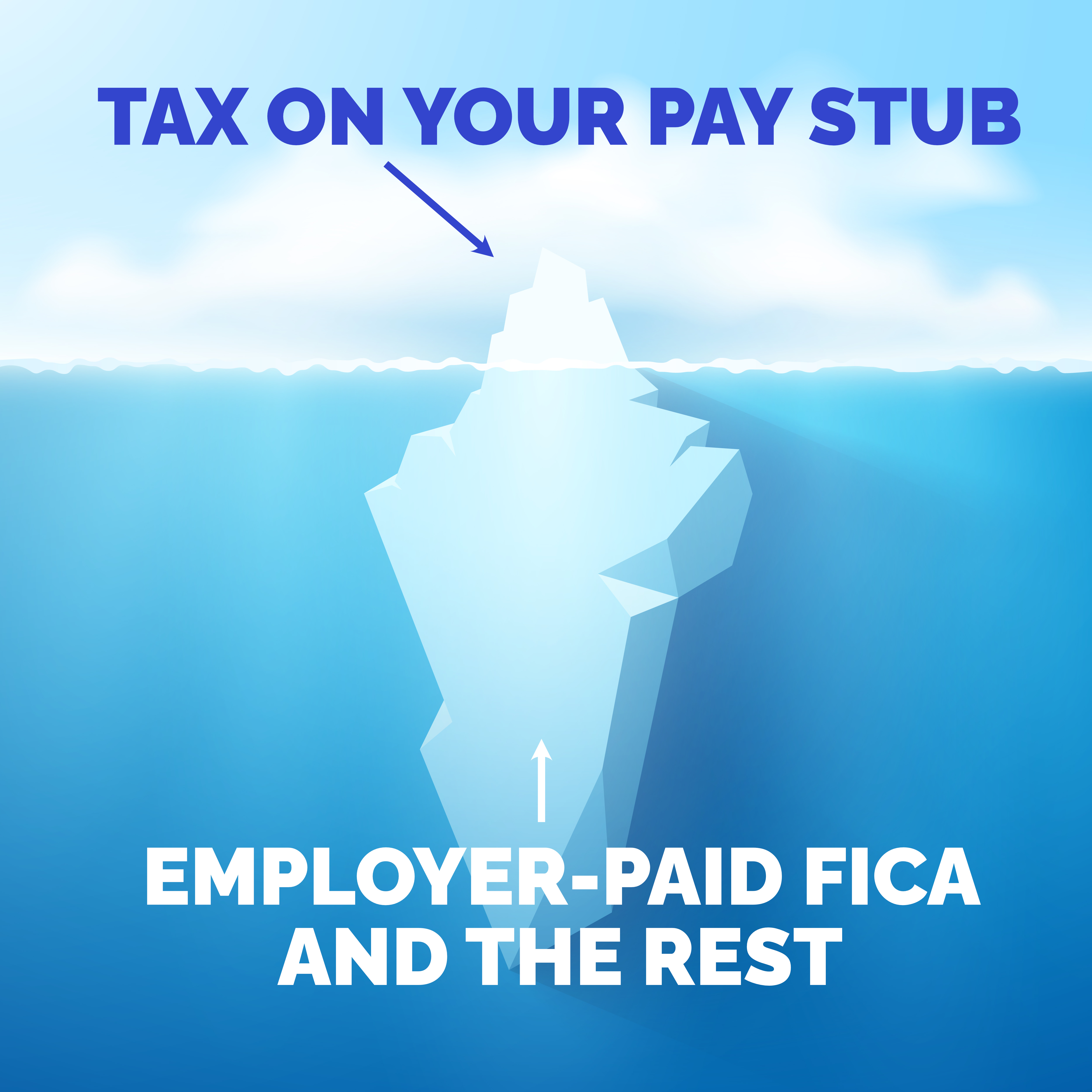
Randy’s Completely Hidden Tax: Most employees have an abstract knowledge of this and, as a result, do not realize the consequences. The $7,650 on Randy’s pay stub is only half of the FICA tax actually paid on his $100,000 of income. The full amount was $15,300.
Why doesn’t the employee pay the full amount directly? When FICA was enacted into law, Congress required employers to pay the other half on employees’ behalf. Why is this significant? First, it represents untaxed earnings — income Randy’s employer could have just as easily paid directly to him. How might Randy feel if he knew that was an option? And second, it’s completely hidden from the employee. Imagine the shock of Randy finally looking at his pay stubs and seeing ANOTHER $7,650 in taxes!
Here’s a breakdown of Randy’s tax on $100,000 of income.

Employee withholding and hiding half of FICA were shrewd moves by Congress. SNEAKY!
Taxes Paid by Self-Employed Jane and Employee Randy

Side by side, the difference is hard to miss. The self-employed person writes a check for about $25,730. Count the half Congress hid in the employer's tax bill, and the W-2 employee pays about $32,160 - about $6,430 more. The self-employed person is not paying any more tax. They just see the whole invoice at once.
Bottom Line: Remove the veil from employer-paid FICA, and it’s obvious employees pay substantially more in taxes. Even if we pretend the employer-paid half of FICA isn’t Randy’s and remove it from the equation, the totals are close, with Jane, the self-employed accountant, paying $1,220 more in total tax.
The Questions Begged
Why do so many self-employed people feel sucker-punched by a thief when forced to write a $25,000 check to the Treasury, while most employees, who pay MORE in tax, grow giddy if the government grants a small tax refund? The answer is simple: The psychological impact of withholding.
The removal of employee taxes before they can see, touch, or spend the income effectively pushes the money out of their thoughts and removes all emotional attachment. In short, withholding detaches employees from tax-paying reality.
The self-employed, on the other hand, have this reality shoved in their face while it digs into their pockets. They are forced to segregate and not to touch up to 50% of their earnings, depending on their income and state, each year. They see the money. They touch the money. They EARNED the money. They just can’t use it to buy groceries, make a mortgage payment, pay for the kid’s braces, or invest it in a retirement that's guaranteed to be there. Instead, they are forced to hand it over, fully aware of the better use it could be put to and the waste it will ultimately fund.
Imagine what would happen if tax withholding disappeared and employees were forced to pay the taxman directly from their pockets. How many would question the amount? How many would demand accountability for the use of their hard-earned income? How many would vote differently? How many might simply refuse to pay?
Well, we have good news! You do not have to imagine. Fear of taxpayer questions, scrutiny, and refusal to pay is what got us here: Mandatory withholding sold as taxpayer convenience.
Employer Withholding: Congress's Sinisterly Brilliant Move
How the US learned the lesson:
Want people’s money, take it before they realize it’s theirs.
The first federal income tax in the United States was imposed during the Civil War, with the signing of the 1861 Revenue Act as an “emergency measure.” The tax was a flat 3%. It was imposed on residents in non-Confederate states with annual incomes exceeding $800. ($30,700 in 2026 dollars). Because there was no effective collection apparatus, no revenue was collected, and the tax was quickly abandoned and replaced by the Revenue Act of 1862.
The 1862 Revenue Act was the precursor to modern US taxation. It included the first exception, a $600 deduction from gross income, and the first graduated tax rate (3% on taxable income up to $10,000, and 5% thereafter). It also created the Office of the Commissioner of Internal Revenue, the IRS’s great-grandpappy, and the first annual tax returns. Two years later, the Revenue Act of 1864 increased rates and lowered marginal brackets.
The US's initial foray into income taxation ended in 1872, as the public realized that both the war and the emergency were over and demanded the tax’s repeal. For the next few decades, partially caused by a Supreme Court shoot-down, the United States returned to its historical revenue-generating mechanisms, tariffs and excise taxes (sound familiar?).
How Withholding Arrived on US Shores
The 1862 tax may have been a temporary measure, but it created two very important precedents. First: The Supreme Court unanimously upheld the constitutionality of the Civil War Income Tax as an indirect tax (Springer v. US, 1881). This ruling was later reversed in 1895 for certain types of income (specifically, investment income & rents) after Congress reimposed income tax via the 1894 Wilson-Gorman Tariff Act (see Pollock v. Farmers' Loan & Trust Co., 1895). This decision led directly to the Sixteenth Amendment to the Constitution in 1913, legalizing the modern broad-based income tax.
IMPORTANT DENIER NOTE: THE INCOME TAX IS CONSTITUTIONAL – IT’S PART OF THE CONSTITUTION!
Secondly, and most important for our conversation, the 1862 income tax stole a British tactic to address 1861’s Revenue Act’s failure to force compliance: Withholding.
Here’s the backstory: In 1799, about a decade after giving up on fighting the US revolution, the British imposed an income tax to finance their perennial war with France. The tax was formally called the Duties on Income Act 1799 (also called Pitt’s Tax, after its creator, William Pitt). The tax was voluntary (ironically meaning payers self-report liability, not that payment is in any way voluntary), with those committing perjury by filing false returns facing a penalty costing $4,000 in today’s US dollars and up to six months in jail.
Even though only 3% of the population (easily identified by authorities) were subject to the tax, the act failed miserably, despite the threat of jail. Overall, 40% of income was unreported, with a whopping 75% of business income omitted from returns.
The British Discover Psychology
In 1801, an innovative chap by the name of Henry Addington replaced William Pitt as Prime Minister and Chancellor of the Exchequer (Finance Commissioner). Addington, intent on increasing both public opinion and treasury revenue, took several steps to assure compliance.
First, he scrapped 1799’s Duties on Income Act. Even though most citizens were not touched by the tax, they despised the thought of the Crown demanding a slice of anyone’s hard-earned livelihood.
So, to hide the fact that livelihoods were involved, Addington took his second step: He removed the word INCOME from his soon-to-arrive creation and named it something as confusing and bureaucratically innocuous as he could muster. The new law’s title, which replaced the income tax with an income tax in 1803, was formally dubbed “An Act for granting to His Majesty, until the sixth Day of May next after the Ratification of a Definitive Treaty of Peace, a Contribution on the Profits arising from Property, Professions, Trades, and Offices.”
The marketing was brilliant. “Contributions on the Profits” sounds far more friendly than “Taxing of Income.” Contributions are voluntary (these were not) and profits come from businesses, not one’s wages (wages were taxed). Another selling point - the tax was temporary, only lasting until the end of the war with France. And it was. When the war finally ended with Napoleon’s defeat in 1815, public outcry successfully forced its demise, despite the government’s attempts to keep it.
Addington’s third step further reduced public outrage by separating income sources on five separate schedules (A to E) so filers saw small buckets of tax not a single lump sum.
Step Four: Stoppage at Source – Withholding to Remove Resistance: The fourth, and by far the most effective, step Henry Addington took was called “Stoppage at Source.” Stoppage at Source required payers of someone else’s income to withhold and remit a portion of that income directly to the Treasury. The rule applied to a vast array of income – tenants withheld from landlords, employers from wages (although the average private employee did not earn enough to be subject), the government from contractors & pensions, and banks and bond payers withheld tax on interest, etc.
Withholding was a game changer. Even though the tax rate was cut in half (from 10% to 5%), Addington’s 1803 tax produced the same amount of revenue as the 1799 income tax, meaning the compliance rate had doubled. And he also discovered that compliance remained, even as the tax rate doubled back to 10% over the following years!
We’ll discuss the psychology shortly, but the success highlights two basic principles: 1) those withholding the tax don’t care, because it’s not their money; and 2) those having the money withheld lose attachment to the income. Their budgets adjust as quickly as they fail to realize how much of their livelihoods is seized by their government.
Withholding Returns to the US (Big Time)
Immediately after the passage of the 16th Amendment, which reads The Congress shall have power to lay and collect taxes on incomes, from whatever source derived, without apportionment among the several States, and without regard to any census or enumeration, the income tax returned with the Revenue Act of 1913. The tax only applied to the very wealthy for nearly 30 years, so there was no need for a withholding mechanism.
This all changed when the bill for World War II came due. The Revenue Act of 1942 - which included an income tax called the Victory Tax - broadened the income tax to the middle class. Individual returns jumped from about 7.7 million in 1939 to about 50 million by 1945. Stripping all that money from well-trained soldiers, veterans and their families as they sacrificed to defeat tyranny was going to be a mess (if not dangerous). Additionally, polling found that less than 15% of taxpayers saved anything to pay the tax as it became due in the spring. Congressional testimony echoed with the warning that if an alternative was not found, “taxpayer will simply throw up their hands and say ’Try and collect.’”
Fortunately, that alternative existed. After the Great Depression, Social Security was established and started withholding in 1937 to provide a stipend for poor seniors after they left the workforce. So, Congress utilized this precedent and passed the Current Tax Payment Act of 1943, signed June 9, 1943. Beardsley Ruml - Macy's treasurer and chair of the New York Fed - sold the country on the maneuver as "pay-as-you-go” taxation. Withholding was both a courtesy and convenience – a proverbial holiday layaway program to avoid the tax-time crunch.
Interestingly, Milton Friedman, then a young Treasury economist, helped design the withholding machinery. It was a move he later regretted (to say the least). Why? Withholding effectively masked the amount taxpayers paid making unchecked government growth, waste and intrusion far too easy. Withholding enables a direct assault on individual liberty and the money it pulls from the productive economy slows the increasing prosperity of all.
From Two Lucky People: Memoirs (Milton and Rose D. Friedman), regarding withholding (pg 123):
“It never occurred to me at the time that I was helping to develop machinery that would make possible a government that I would come to criticize severely as too large, too intrusive, too destructive of freedom. Yet, that is precisely what I was doing. Rose has repeatedly chided me over the years about the role that I played in making possible the current overgrown government we both criticize so strongly. … There is an important lesson here. It is far easier to introduce a government program than to get rid of it. … Truly, the road to Leviathan is paved with good intentions.”
Because employers take the tax out of every paycheck, quietly, before employees could spend it - or add it up. The bill is hidden in plain sight, and to the vast number of those paying it, it’s little more than numbers on the sheet they get with their paycheck. SNEAKY!
The Psychology of Withholding
The psychological impact of withholding on human behavior is well documented. Countless studies help explain why the self-employed are fully aware of and sickened by the amount they pay while employees, who pay even more, tend to view taxation as a vague abstraction far removed from their lives. Here are the mechanisms behind this phenomenon.
Detachment from Income (Salience & Prospect Theory): Because withholding removes the income before taxpayer can spend it, they do not realize it was available. In other words: Employees do not feel the money leaving, so they fail to grasp that it was theirs to start with.
Withholding reduces attachment by reducing “salience,” which basically means “noticeability.” If you don’t realize you own something, you’re not upset when it disappears. On the other hand, if you worked to buy a car, you know the car is yours. As a result, you might be a tad upset if the government forces you to give the title for your car to a neighbor.
This is where Prospect Theory comes in: humans hate losing more than they enjoy winning. When withholding is present, most people don’t even realize they lost something, yet a small refund fires up the dopamine. Those forced to pay their own taxes, however, face a far different reality. Prospect Theory helps explain much of the difference in compliance and evasion. Those with taxes withheld don’t realize they’re complying with tax laws, while those who evade or refuse to pay are fully aware of how much compliance costs (and how much it hurts!).
Want to learn more? Check out this paper: A Prospect Theory Account of the Income Tax Withholding Phenomenon
Mental Accounting and Tax Shifting: Humans do not behave rationally when it comes to money, particularly when it comes to the timing of its reception. We might temporarily notice marginal changes in our net pay, but the change is quickly forgotten.
For example, If I regularly receive a tax refund and use it to fund my IRA or pay for vacation, I will not do the same thing if the same refund is reduced, divided up and added to my paychecks. My “mental accounting” buckets paychecks as spending money and my budget quickly absorbs the additional funds. What takes the hit? My IRA and vacation.
The point – I don’t even notice taxes! I'll only consider taxes if my refund arrives far lower than expected or, goodness forbid, I have a giant bill. Mental Accounting taught the government a very valuable lesson – to maximize revenue while avoiding public outrage, work to ensure taxpayers consistently receive small refunds (or owe just a little). If it can, taxpayer won’t even consider the amount of tax they pay. Why? Taxes don’t have mental bucket!
You know who has a mental tax bucket? Those who know how much they must pay - the self-employed!
Here’s more info: Mental Accounting Effects of Income Shifting
Those are the primary psychological mechanisms that make withholding so effective (and sneaky!). The there are many more, but they are all closely related to those discussed above. We’ll highlight a few.
Fiscal Illusion: Because withholding hides the amount of tax we pay, we are far less likely to consider how large government becomes, how it spends our money, how intrusive it becomes, or how much debt it borrows for us to repay later.
Inertia / Default Bias: Because withholding pushes our income so far from conscious thought, we are unlikely to change the amount withheld, regardless of rates. If you’re a W-2 client (particularly in a two-earner household) who owes at filing time, you’ve heard my spiel about the worthlessness of the withholding tables, followed by instructions to increase the amount of tax removed per pay.
Moral Disengagement & Reduced Personal Responsibility: Because a trustee (employer or retirement) handles the tax for us, we become disengaged from the amount plucked from our wallets. To reiterate a recurring theme – withholding blinds us to the amount we pay.
The End - Thank You!
I hope my efforts have awakened readers to a weakness we share. When our property is taken, legally or otherwise, before we realize it is ours, a vast sum can quickly disappear unnoticed. Maybe this new-found awareness will prod us to take a serious look at our paystubs and W-2s and ask whether the amount separating gross pay and net pay benefits our families and futures. Perhaps, we’ll even take a sober look at the US Debt Clock (now over $40,000,000,000,000), which our future paycheck must repay, and ask a simple question: “What?!!!”
Thank you again for your trust, your patience, and every referral you send our way - our practice grows one friend at a time, and that's because of you. Questions? Email us - we're always happy to help.
All courses and articles are for informational purposes only and do not constitute tax advice. Taxes are complicated - do not act on course information without consulting a professional. Always refer to treasury regulation before making any tax decision. Read the full disclaimer.