 Overnight

What the 2025 tax law changed and which year each record belongs to
If you are wondering what paperwork to start saving for the new tax rules, the short answer is this: keep records labeled by tax year, because the law's provisions did not all start at once. The 2025 tax law is Public Law 119-21, signed July 4, 2025. The IRS calls it the Working Families Tax Cuts law. You will also see it called the One, Big, Beautiful Bill (OBBB) or One Big Beautiful Bill Act. The video transcript behind this guide uses the Working Families Tax Cuts name, so all three labels refer to the same law.
Quick answer. Several new deductions depend on documents you either receive from someone else or have to create yourself. Gather them by the year they apply to, not by the name of the law.
2025 returns. Deductions for qualified tips, qualifying overtime compensation, and certain vehicle-loan interest apply to tax years beginning after December 31, 2024. The tips deduction is capped at $25,000. The overtime deduction is capped at $12,500 ($25,000 for joint filers). Both phase out above $150,000 of modified adjusted gross income ($300,000 for joint filers). The 2025 standard deduction is $15,750 for single filers, $23,625 for heads of household, and $31,500 for joint filers.
2026 and later. The 2026 standard deduction under Revenue Procedure 2025-32 is $16,100 for single filers and married filing separately, $24,150 for heads of household, and $32,200 for joint filers and qualifying surviving spouses. The transcript's $32,200 joint figure matches. The Child and Dependent Care Credit rate rises from 35% to 50% of qualifying expenses starting in 2026, with expense limits staying at $3,000 for one qualifying individual and $6,000 for two or more. Trump Account contributions may begin July 4, 2026, and employers may add up to $2,500 per year.
One transcript claim to treat carefully. The transcript says the 2017 tax rates are now permanent. I have not tied that phrase to a specific IRS page for this guide, so do not build a plan around it.
Practical habit. Because start dates differ, keep forms, statements, receipts, and eligibility records for each provision in a folder marked with its tax year.
This is general information, not advice for your situation. A tax professional can tell you how these rules apply to you.
Tips and overtime: the W-2 boxes, pay records and lists to pull together
Both deductions go on a new schedule (Schedule 1-A), and both depend on records your employer may not break out for you. The tips deduction is worth up to $25,000 per return, and the overtime deduction up to $12,500 ($25,000 for joint filers). Both apply for 2025 through 2028 and shrink once modified adjusted gross income passes $150,000 ($300,000 joint). Married couples generally need to file jointly, and a valid Social Security number is required.
Employees
- Form W-2, all boxes. Box 1 is taxable wages, Box 12 holds lettered codes for special items, and Box 14 is a free-form line some employers use. The transcript says overtime shows up as code TT in Box 12. I could not match that code to an IRS page, so treat it as unconfirmed and ask payroll how your employer reports overtime premium pay.
- Pay stubs for every overtime week. You need your regular hourly rate, overtime hours, and the overtime rate.
- A split of premium pay from base pay. Only the amount above your regular rate counts. Under the Fair Labor Standards Act (FLSA), overtime is generally owed after 40 hours in a workweek at no less than 1.5 times the regular rate. On $24 an hour, time-and-a-half is $36, and the qualifying part is the extra $12 per hour. The $24 portion is ordinary wages. If your employer pays double time, only the half-time premium the FLSA requires qualifies.
Tipped workers
- Your W-2 and its tip occupation code. The transcript says the W-2 should show a Treasury tip occupation code. Check this on your own form, since employers may be slow to add it.
- The IRS occupation list. Qualified tips must come from a job on the list of occupations that customarily and regularly received tips on or before December 31, 2024. Compare your job title and duties to it. The transcript says law, accounting, consulting and financial services are excluded.
- Tip records. The IRS lists tip logs, point-of-sale reports, tip-pool records, and pay stubs as useful support.
- Proof the money was a tip. Qualified tips are voluntary customer tips, cash or charged. A mandatory service charge generally is not a tip, so note which payments were automatic.
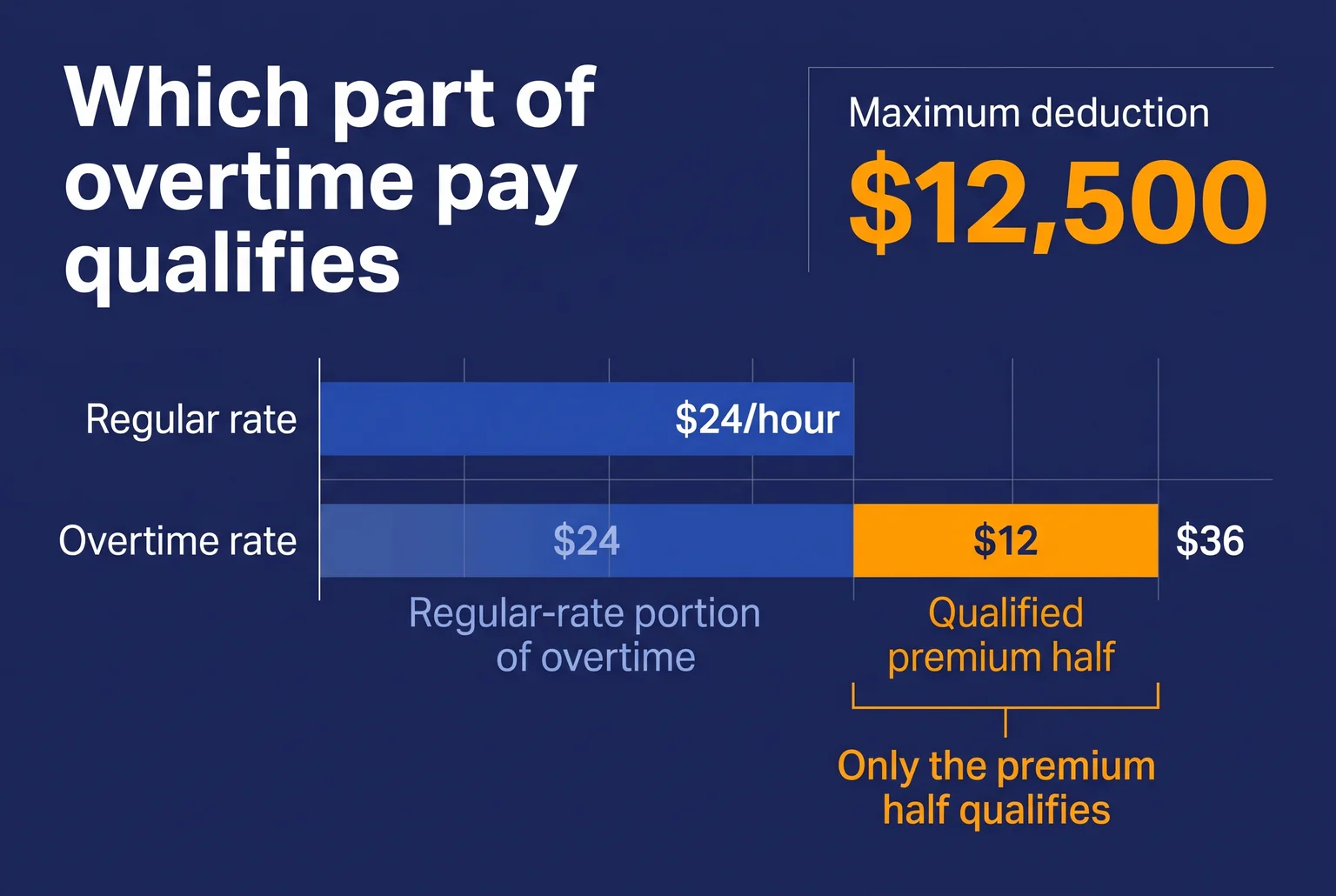
Only the extra half of time-and-a-half pay counts toward the overtime deduction, so separate it from regular wages.
Self-employed tipped workers
- Forms 1099 or platform statements showing tips received.
- A tip log kept as you go, plus receipts and records for the business that earned them.
- Your net business income. The deduction cannot exceed net income from that business before the deduction, so keep the expense records that produce that figure.
Both deductions can be claimed whether or not you itemize. Guidance on employer reporting is still developing, so if your W-2 lacks a code or a breakout, keep your own pay stubs and logs as the backup.
This is general information, not advice for your situation. A tax professional can tell you how these rules apply to you.
Records for 1099 income, platform sales and business mileage
Income is taxable whether or not a form arrives. The 2026 reporting thresholds decide who sends you a form, not what you owe tax on, and the 1099-MISC and 1099-NEC instructions say business income must be reported even without a Form 1099.
Form 1099-NEC and 1099-MISC. For payments made after December 31, 2025, the reporting threshold rises from $600 to $2,000 for certain payments, and it applies to calendar-year 2026 payments. The $2,000 figure is fixed for 2026 and adjusts for inflation after that. A client who paid you $1,500 may send nothing, so keep your own invoices, contracts, and bank deposits for every payer.
Form 1099-K. The transcript says payment apps issue a 1099-K only above $20,000 and 200 transactions. Whatever the threshold, a missing form changes nothing about what you report. The IRS says to keep platform statements, transaction-level sales records, refund and fee records, and any Forms 1099-K. It also suggests documenting which sales were personal items and which were business or gig income, then reconciling the reported gross payments to what you actually received.
Mileage log. The 2026 rates are 72.5 cents per business mile, 20.5 cents per medical or moving mile, and 14 cents per charitable mile. The same notice says you need adequate records to back up a mileage deduction. A log should capture:
- Trip date and locations
- Business purpose
- Business miles for the trip
- Total vehicle mileage for the year
- Parking and toll receipts
An owner generally chooses the standard-mileage method in the first year a vehicle is placed in service, and a lessee must use it for the whole lease. It covers gasoline, diesel, hybrid, and electric vehicles.

A trip log on your phone and a folder of toll and parking receipts together back up a mileage deduction.
Expense and tip records. Keep receipts or statements for each business cost, since they set your net income. Tipped gig workers should keep a running tip log, as covered in the previous section.
This is general information, not advice for your situation. A tax professional can tell you how these rules apply to you.
Records for itemizing, charitable gifts and vehicle loan interest
Three categories of paperwork decide whether these deductions survive a review: home and tax statements, donation receipts, and auto loan files. The rules differ by tax year, so the labels below say which applies.
Homeowners
- Form 1098. Form 1098 is the mortgage interest statement your lender sends. Keep it with your closing documents and annual loan statements.
- Property tax bills and payment confirmations. Keep the bill and proof of payment (a bank record or receipt).
- State and local income or sales tax records. These, together with property tax, make up SALT, meaning state and local taxes. Records relevant to SALT include tax bills, income or sales tax records, and payment confirmations.
The SALT cap is temporarily higher for 2025 through 2029, and the deduction phases down for higher incomes to a floor of $10,000. The transcript says the cap is $40,400 for 2026. I could not tie that figure to an IRS page, so check the current Schedule A instructions before you rely on it.
Donors
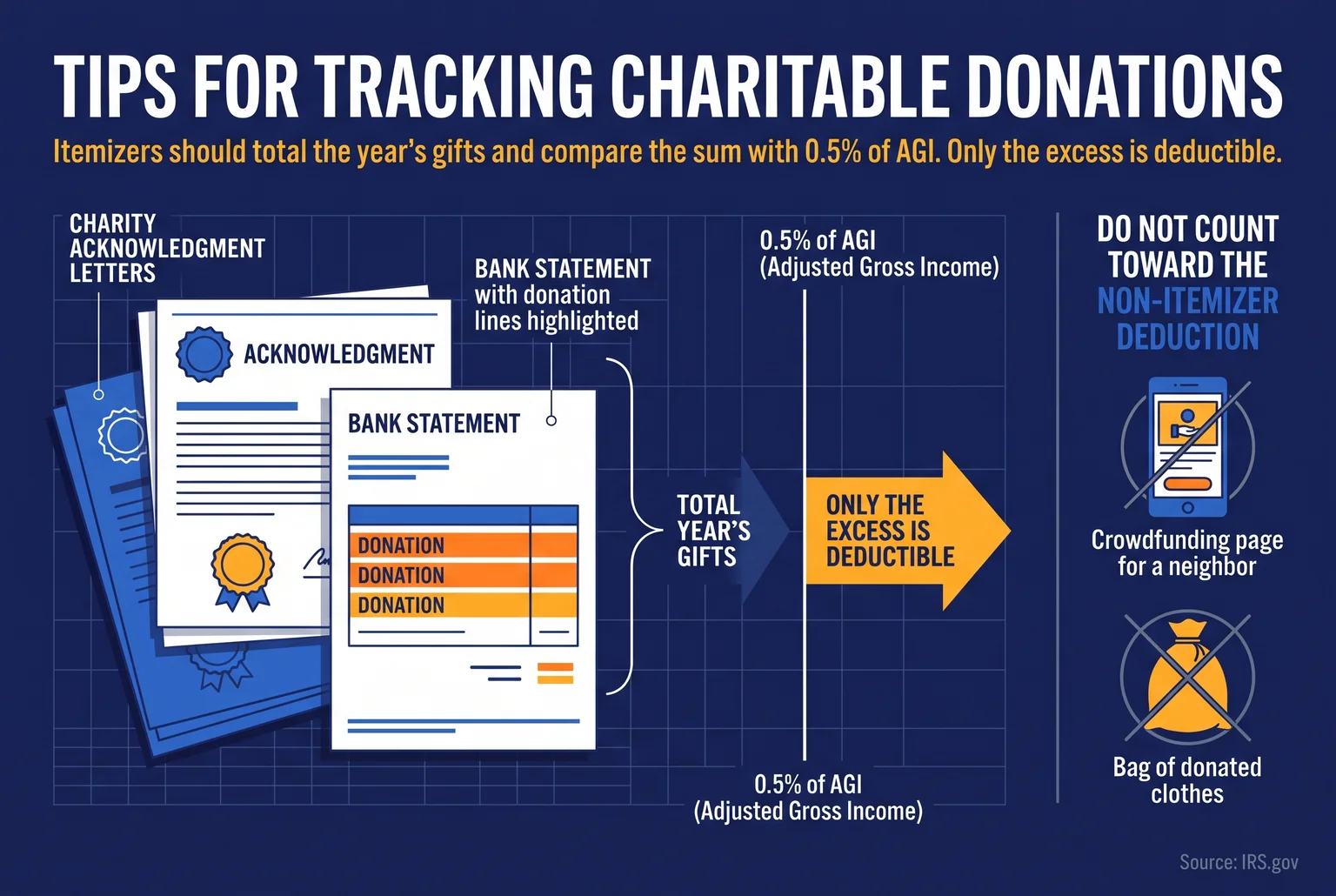
Two different rules start in 2026. Itemizers can deduct only charitable gifts above 0.5% of AGI (adjusted gross income, the total on your return before deductions), per the 2026 Form 1040-ES. Filers who do not itemize can deduct up to $1,000 of qualifying cash gifts, or $2,000 on a joint return. For 2025 returns, neither applies.
- A written acknowledgment from the charity for any single gift of $250 or more.
- Bank or card records for smaller cash gifts.
- Proof the recipient is an eligible organization. Gifts to individuals and noncash property do not count toward the non-itemizer deduction, so a crowdfunding page for a neighbor or a bag of donated clothes will not help.
Itemizers should total the year's gifts and compare the sum with 0.5% of AGI. Only the excess is deductible.
Vehicle buyers
The deduction for qualified passenger-vehicle loan interest is capped at $10,000 a year. It phases out above modified AGI of $100,000 for single filers and $200,000 for joint filers. The loan must have started after December 31, 2024, be for a personal-use vehicle, and be secured by a lien on it. The transcript adds that the vehicle must be new, assembled in the United States, and under 14,000 pounds.
The IRS lists these records for a claim:
- Lender statement showing interest paid for the year
- Loan documents and purchase contract
- Payment history
- VIN (vehicle identification number)
- Evidence of U.S. final assembly, such as the window sticker or the VIN decode
Lenders must send statements showing total interest received, though the IRS has given them transitional relief for 2025 reporting. If no statement arrives for 2025, ask the lender for a year-end interest figure and keep the request.
This is general information, not advice for your situation. A tax professional can tell you how these rules apply to you.
Records for family credits, savings accounts, coverage and retirement
Most of these items depend on a Social Security number or a single IRS form, so the list is sorted by who is gathering. Several benefits start in 2026, so years are labeled.
Parents
- Social Security numbers. For the Child Tax Credit, you (and your spouse on a joint return) and each qualifying child need an employment-valid SSN issued by the return due date, including extensions. The credit is up to $2,200 per child for 2025, with up to $1,700 refundable.
- Dependent care receipts. Keep receipts showing amounts paid and the provider's name, address and tax ID. Starting in 2026, the credit rate can reach 50% of expenses up to $3,000 for one person or $6,000 for two or more. If your employer offers a dependent care benefit, the 2026 exclusion rises from $5,000 to $7,500, so keep the pay stub or benefits statement showing what you set aside.
- Trump Account paperwork. Form 4547 elects an initial account and requests the $1,000 pilot deposit for a U.S.-citizen child with an SSN born after December 31, 2024 and before January 1, 2029. Contributions and deposits cannot occur before July 4, 2026, and the annual limit is $5,000, with exclusions for the pilot deposit, qualified general contributions and qualified rollovers. Treasury or its agent sends activation information after you elect, so keep that mail. Expect more guidance, since the rules are new.
Marketplace coverage and HSAs
- Form 1095-A. Your marketplace sends it, and it supports the premium tax credit reconciliation on Form 8962. Repayment caps on excess subsidy are eliminated for 2026, so a mismatch between advance payments and final income can mean a full repayment. Keep a record of income changes during the year.
- HSA records. Beginning January 1, 2026, bronze and catastrophic individual-market plans count as HSA-compatible, and HSA funds can pay periodic direct primary care fees. Save plan documents showing the plan type, plus monthly direct primary care invoices.
Seniors
The senior deduction is claimed on Schedule 1-A, Part V, and married couples must file jointly. It phases out above modified AGI of $75,000 (single) or $150,000 (joint). The amount is $6,000 per person age 65 or older. Keep proof of birth date and an SSN for each spouse.
Retirement savers
Keep year-end 401(k) and IRA statements showing contribution type. People with 2025 wages over $150,000 must make catch-up contributions to Roth accounts, so your W-2 and plan statement should show how those contributions were classified.
This is general information. A tax professional can tell you how these rules apply to you.
Income thresholds that shrink these deductions
Several of the new deductions shrink as modified adjusted gross income (MAGI) rises. The senior deduction phases out above $75,000 (single) or $150,000 (joint). The car-loan-interest deduction phases out above $100,000 ($200,000 joint). The tips and overtime deductions phase out above $150,000 ($300,000 joint), reduced by $100 for each $1,000 of excess MAGI.
For tips and overtime, MAGI starts with AGI and adds back specified foreign-income exclusions and deductions, including amounts claimed under the foreign earned income rules.
Bonuses, equity compensation, investment gains, business income and retirement distributions all feed into AGI or MAGI. If you are near a threshold, keep:
- Final pay statements and your W-2
- Brokerage statements
- Business records for Schedule C, E or F income
- Equity-compensation documents
- Foreign-income paperwork, if any
Where you land relative to a limit can turn on a few thousand dollars, so a tax professional can answer threshold-specific questions.
Your 2026 records checklist, by category
Tips, overtime, senior and car-loan deductions go on Schedule 1-A, which you can claim even if you itemize. Everything below is for 2025 returns filed in 2026.
Income forms - Forms W-2, with tip and overtime amounts shown separately - Forms 1099-K and 1099-NEC, matched to platform statements and bank records - Your and your spouse's Social Security numbers
Receipts and mileage - Mileage logs: date, destination, purpose, miles - Charity acknowledgments
Vehicle and home records - Loan interest statements and purchase paperwork for a new vehicle - Form 1098, closing disclosures, property-tax bills, improvement receipts
Family and health forms - Form 1095-A and Form 8962 for marketplace coverage - Dependent care, adoption and medical-expense records - Form 4547, if you elected a Trump Account
Retirement and savings statements - Retirement contribution and HSA statements
How long to keep them Keep returns and support for three years in the usual case. The period is six years if you left out income exceeding 25% of the gross income on your return, and indefinitely if you never filed. Employment tax records need four years. Hold property records until the period for the sale or disposition closes.
Taxes are complicated, and this checklist covers general rules, not your situation. Consult an enrolled agent or CPA before acting.
Sources
- Working Families Tax Cuts: Tax deductions for working Americans and seniors — Internal Revenue Service
- One, Big, Beautiful Bill: How to take advantage of no tax on tips and overtime — Internal Revenue Service
- Working Families Tax Cuts – Individuals and workers | Internal Revenue Service — Internal Revenue Service
- Rev. Proc. 2025-32 — Internal Revenue Service
- Working Families Tax Cuts | Internal Revenue Service — Internal Revenue Service
- Questions and answers about the new deduction for qualified overtime compensation — Internal Revenue Service
- Occupations that customarily and regularly received tips on or before Dec. 31, 2024 — Internal Revenue Service
- Tip recordkeeping and reporting — Internal Revenue Service
- Instructions for Forms 1099-MISC and 1099-NEC (12/2026 ... - IRS — Internal Revenue Service
- Internal Revenue Bulletin: 2026-19 | Internal Revenue Service - IRS — Internal Revenue Service
- Form 1099-K FAQs: What to Do If You Receive a Form 1099-K — Internal Revenue Service
- 2026 Standard Mileage Rates - IRS — IRS
- About Form 1098, Mortgage Interest Statement — IRS
- Publication 6079 (Rev. 5-2026) - IRS — Internal Revenue Service
- 2026 Form 1040-ES - IRS — Internal Revenue Service
- Topic no. 506, Charitable contributions | Internal Revenue Service — Internal Revenue Service
- Tips for tracking charitable donations — IRS
- What you will need to file your taxes under Working Families Tax Cuts — IRS
- Working Families Tax Cuts - Businesses | Internal Revenue Service — Internal Revenue Service
- Refundable tax credits | Internal Revenue Service — Internal Revenue Service
- Child and Dependent Care Credit information | Internal Revenue Service — Internal Revenue Service
- Instructions for Form 4547 (12/2025) | Internal Revenue Service — Internal Revenue Service
- Publication 6142 (Accessible) — Internal Revenue Service
- What to know about the No Tax on Overtime deduction — IRS
- 2026 Schedule 1-A (Form 1040) - IRS — Internal Revenue Service
- Instructions for Schedule 1-A (Form 1040) — Internal Revenue Service
- How long should I keep records? | Internal Revenue Service — Internal Revenue Service
All courses and articles are for informational purposes only and do not constitute tax advice. Taxes are complicated - do not act on course information without consulting a professional. Always refer to treasury regulation before making any tax decision. Read the full disclaimer.